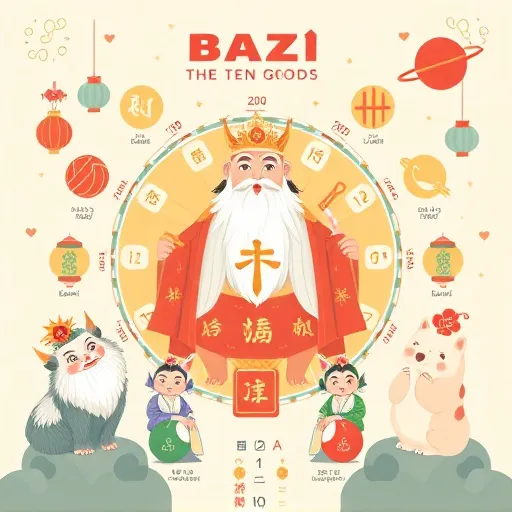
Bazi the Four Pillar
What Is Bazi and Where Do the Ten Gods Fit In?
If you've ever fallen down a rabbit hole of Chinese metaphysics, you've probably bumped into Bazi — also called the Four Pillars of Destiny. Bazi is a traditional system that maps out a person's life using their birth date and birth time. The word itself literally translates to "eight characters," and here's why: you've got four pillars (year, month, day, and hour), and each pillar is made up of a Heavenly Stem paired with an Earthly Branch. Four times two equals eight. Pretty straightforward, right? But from those eight little characters, a whole blueprint of your personality, tendencies, and life themes starts to take shape. This is exactly where a solid bazi ten gods explained for beginners walkthrough becomes so valuable.
Now, the Ten Gods are a second layer of interpretation that sits on top of the basic Bazi chart. They describe the relationship between your Day Master — that's the Heavenly Stem of your birth day, the character that represents you — and every other element in your chart. Picture the Day Master as the main character in a movie, and the Ten Gods as the supporting cast. Each one plays a distinct role in shaping your life narrative. When you look at bazi ten gods explained for beginners material, this protagonist-and-cast metaphor is honestly the easiest way to wrap your head around it.
What makes the Ten Gods so handy is that they take abstract ideas like elements and polarity and translate them into human archetypes. Instead of a practitioner saying "your chart has a lot of Metal," they can say "you have strong Direct Officer energy" — and suddenly you can picture how that energy might play out in your career, your relationships, and your decision-making. That's the magic of bazi ten gods explained for beginners in a nutshell: it turns dense theory into something you can actually feel.
The Foundational Building Blocks: Five Elements, Yin-Yang Polarity, and Day Master Relationships
Before we dig into each god individually, we've gotta cover the foundation. The Bazi system rests on two core concepts. First, the Five Elements: Wood, Fire, Earth, Metal, and Water. Each element has a productive cycle (Wood feeds Fire, Fire creates Earth, Earth bears Metal, Metal carries Water, Water nourishes Wood) and a controlling cycle (Wood controls Earth, Earth controls Water, Water controls Fire, Fire controls Metal, Metal controls Wood). Second, Yin and Yang: every element exists in two polarities — a receptive, inward Yin expression and an active, outward Yang expression.
Combine five elements with two polarities and you get ten possible relationships between any two elements. That's literally where the Ten Gods come from. Each god represents a specific elemental relationship between your Day Master and another character in your chart. Understanding this math is the backbone of any bazi ten gods explained for beginners guide, because once you see the pattern, the names stop feeling random.
The Complete Ten Gods Lineup: Friend, Rob Wealth, and the Five Relationship Categories
Here's the full roster. The names sound dramatic, but each one describes a functional relationship:
- Friend (same element, same polarity)
- Rob Wealth (same element, opposite polarity)
- Eating God (element you produce, same polarity)
- Hurting Officer (element you produce, opposite polarity)
- Direct Wealth (element you control, opposite polarity)
- Indirect Wealth (element you control, same polarity)
- Direct Officer (element that controls you, opposite polarity)
- Seven Killings (element that controls you, same polarity)
- Direct Resource (element that produces you, opposite polarity)
- Indirect Resource (element that produces you, same polarity)
See the pattern? Five elemental relationships (same, output, wealth, power, resource), each in two flavors based on polarity. Ten gods, five categories — that's the elegant structure underneath. Any good bazi ten gods explained for beginners breakdown should hammer this symmetry home, because it makes memorization way less painful.
Self and Output Categories: Friend, Rob Wealth, Eating God, and Hurting Officer
Friend and Rob Wealth share your Day Master's element. Friend represents peers, siblings, and collaborators who support you — reliable teammate energy. Rob Wealth is the same element but opposite polarity, creating a more competitive, assertive dynamic. In modern terms, Friend is the colleague who has your back, while Rob Wealth is the rival who pushes you to level up. Too much of this energy can signal stubbornness or a tendency to butt heads with authority.
Then there's the output category — the element your Day Master produces, meaning your creative expression, talents, and communication style. Eating God is the gentler, refined version: creativity expressed through patience and craft. Hurting Officer is bolder and more rebellious: quick-witted, outspoken, brilliant at breaking conventions. These gods link to fields like writing, design, technology, entertainment, and entrepreneurship — anywhere original thinking gets rewarded. This is the kind of nuance that makes bazi ten gods explained for beginners genuinely click for creative folks.
Wealth and Power Categories: Direct Wealth, Indirect Wealth, Direct Officer, and Seven Killings
Wealth gods represent elements your Day Master controls. Direct Wealth is steady, earned-through-effort income — salary, long-term investments, disciplined saving. Indirect Wealth is more dynamic: windfalls, side hustles, opportunistic gains, entrepreneurial risk. These aren't just about money, though. Wealth gods also reflect how you relate to resources, your sense of practicality, and even partnership dynamics. Someone with balanced wealth stars tends to be grounded, goal-oriented, and good at managing tangible outcomes.
Power gods are the elements that control your Day Master — authority, discipline, structure, and pressure. Direct Officer is the well-behaved version: integrity, rule-following, responsibility, respect for hierarchy. Seven Killings is the wilder version: ambition, risk tolerance, decisiveness, and the capacity to perform under intense pressure. Strong Officer energy often thrives in management, law, government, or corporate leadership, while Seven Killings suits high-stakes fields like competitive business and crisis management. Getting these distinctions right is where bazi ten gods explained for beginners really earns its keep.
Resource Category and Modern Relevance: Direct Resource, Indirect Resource, and 2026 Self-Reflection
Resource gods are the elements that produce your Day Master — symbolizing support, knowledge, mentors, and inner nourishment. Direct Resource relates to formal learning, mentorship, and steady intellectual growth. Indirect Resource is more intuitive: unconventional wisdom, spiritual insight, and learning through life experience rather than textbooks. Strong resource energy often belongs to thoughtful, analytical people — researchers, strategists, advisors, and lifelong learners. Resource stars also represent the support of elders and the ability to recover from setbacks.
So why does an ancient system still matter in 2026? Because the Ten Gods aren't predictions — they're a framework for pattern recognition. In an era where career paths are no longer linear and personal branding matters more than ever, understanding your natural strengths is genuinely valuable. A digital marketer with strong Hurting Officer energy might realize why they keep clashing with rigid corporate structures and pivot toward freelance creative work. Someone with dominant Direct Wealth stars might finally understand why a steady savings plan feels safer than risky investments. This practical angle is exactly what modern bazi ten gods explained for beginners content should emphasize.
What's fascinating is how modern coaching and personality frameworks echo these archetypes. The Ten Gods system predates most contemporary personality models, yet it maps surprisingly well onto leadership styles, communication preferences, and team dynamics. Several professionals describe Bazi as a "mirror" — not a fortune-telling gimmick, but a lens for honest self-assessment.
Common Misconceptions and Beginner Learning Steps for Bazi Ten Gods
Let's clear up a few things beginners often get wrong. "Having a 'bad' god means bad luck" — not true. Every one of the Ten Gods has healthy and unhealthy expressions depending on context. Seven Killings can be destructive, or it can make you a fearless founder. Context is everything. "More gods = better chart" — also false. The system isn't a scoreboard; balance and harmony between elements matter far more than sheer quantity. And "the Ten Gods predict exact events" — nope. They describe tendencies and dynamics, not fixed outcomes. Think weather patterns, not a scripted forecast. Avoiding these traps is half the battle in bazi ten gods explained for beginners territory.
For beginners, take it step by step. First, find your Day Master using a Bazi calculator to identify the Heavenly Stem of your birth day — this is your anchor. Second, map the other stems by checking the relationship between your Day Master and each other character. Third, study one category at a time; don't memorize all ten at once. Start with Self and Output, then move to Wealth, Power, and Resource. Fourth, observe patterns in your real life and compare them with your dominant gods. Many learners keep a journal, noting where specific gods show up in career choices and relationships. Over time, the system feels intuitive rather than abstract — and that's when bazi ten gods explained for beginners stops being theory and starts being personal.
At the end of the day, the Bazi Ten Gods system is neither magic nor mysticism — it's a structured language for describing human tendencies. Once you grasp the five elemental relationships and how polarity creates ten distinct archetypes, the whole framework opens up. In 2026, with self-awareness becoming a genuine competitive advantage, ancient systems like Bazi are finding new audiences among professionals and lifelong learners alike. The more you understand your own patterns, the better equipped you are to make choices that actually fit your nature — and that's precisely why bazi ten gods explained for beginners remains such a sought-after topic.