Five elements of Chi
What Are the Five Elements, and Why Do They Matter?
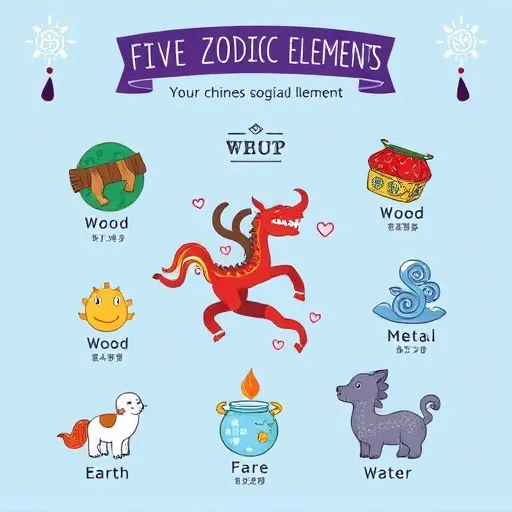
Before we get into the “how,” let's talk about the “what.” Chinese astrology works with five fundamental elements: Wood, Fire, Earth, Metal, and Water. These aren't literal substances — they're archetypal forces that describe patterns of energy, personality, and change. If you've ever wondered how to find your Chinese zodiac element, the answer starts right here with these five forces. Each one carries its own flavor:
- Wood — growth, expansion, vision, flexibility
- Fire — passion, expression, charisma, momentum
- Earth — stability, nourishment, patience, grounding
- Metal — precision, structure, discipline, clarity
- Water — intuition, adaptability, wisdom, flow
What makes this system so elegant is that every zodiac animal is paired with one of these elements, and that pairing shifts on a fixed cycle. This is why, for example, someone born in a Wood Dragon year has a noticeably different temperament than someone born in a Metal Dragon year — even though they share the same animal sign. Knowing how to find your Chinese zodiac element means understanding both layers at play here.
The Fixed Element vs. the Yearly Element: Two Layers of Your Chinese Zodiac Reading
Here's where a lot of people get tripped up. In Chinese astrology, you actually have two elements to consider, and they work together like layers of a painting. Understanding both is the key to how to find your Chinese zodiac element accurately.
The Fixed Element: Your Animal Sign's Native Element and Baseline Energy
Every one of the twelve animal signs has a permanent, built-in element that never changes. Think of it as the baseline frequency of that sign. These fixed elements are assigned like this:
- Rat — Water
- Ox — Earth
- Tiger — Wood
- Rabbit — Wood
- Dragon — Earth
- Snake — Fire
- Horse — Fire
- Goat (Sheep) — Earth
- Monkey — Metal
- Rooster — Metal
- Dog — Earth
- Pig — Water
This fixed element is the one most people are asking about when they search for their “zodiac element,” and it's the easiest to identify once you know your animal sign. It's the first big step in how to find your Chinese zodiac element.
The Yearly Element: Your Birth Year's Rotating Element in the Ten-Year Cycle
On top of the fixed element, each calendar year carries its own element, and these rotate in a ten-year cycle. The pattern works like this: each element appears for two consecutive years — first in a Yang (masculine, active) expression, then in a Yin (feminine, receptive) expression. So you'll see a Water Yang year followed by a Water Yin year, then Wood Yang, Wood Yin, and so on through Fire, Earth, and Metal before the cycle resets.
This is the element you'll find attached to the year in any Chinese astrology reference — the “Year of the Fire Horse,” the “Year of the Metal Ox,” and similar phrasing. When an astrologer or a curious friend mentions your “year element,” this is what they mean. Grasping this rotation is essential for how to find your Chinese zodiac element with real precision.
Step 1: Determine Your Chinese Zodiac Animal Using the Lunar Calendar
Your animal sign is based on your birth year according to the Chinese lunar calendar, not the Gregorian calendar. This is a crucial detail — if you were born in January or early February, your Chinese zodiac year may actually belong to the previous animal. The Chinese New Year typically falls somewhere between late January and mid-February, and the exact date shifts each year.
For example, if your birthday falls in late January, you might technically belong to the animal sign of the year before your birth year. This is one of the most common mistakes people make, so double-check the exact Chinese New Year date for your birth year before committing to a sign. If you already know your animal sign, great — move to Step 2. If not, you can use any reputable online Chinese zodiac calculator that accounts for the lunar calendar transition. Always input your full birth date rather than just the year, so it can handle the calendar boundary correctly.
Step 2: Match Your Animal Sign to Its Fixed Element in the Chinese Zodiac Table
Once you've confirmed your animal sign, look it up in the table above. That's your fixed element — the elemental “home base” of your sign. For instance, if you're a Snake, your fixed element is Fire. If you're a Monkey, it's Metal. This step alone answers a big chunk of how to find your Chinese zodiac element for most people.
Step 3: Identify Your Birth Year's Element Through the Ten-Year Rotation
Now for the yearly layer. Each birth year carries an element, and you can find yours by checking the Chinese zodiac year designation for your birth year. These run on that ten-year rotation of Yang and Yin expressions across the five elements. Most comprehensive zodiac charts list the full “element + animal” combination for every year — for example, “Yang Wood Dragon” or “Yin Earth Rabbit.”
Here's a handy way to think about the ten-year cycle: the last digit of the Gregorian year typically maps to a specific element and polarity. Years ending in 0 and 1 correspond to Metal, 2 and 3 to Water, 4 and 5 to Wood, 6 and 7 to Fire, and 8 and 9 to Earth. Within each pair, the first year is Yang and the second is Yin. This little trick lets you quickly estimate your yearly element once you understand the pattern — a neat shortcut for how to find your Chinese zodiac element without hunting through charts.
Step 4: Combine Both Element Layers for a Fuller Personality Picture
Now you have two elements: your fixed element and your yearly element. Put them together and you get a much richer reading of your personality and tendencies. Some combinations reinforce each other — a Fire sign born in a Fire year, for instance, tends to amplify that fiery intensity. Others create interesting tension or balance, like a Water sign born in an Earth year, where the grounding Earth element meets flowing Water energy.
This combined view is what experienced practitioners use when analyzing compatibility, career timing, and personal strengths. It's also why two people with the same animal sign can feel so different — their yearly elements may be working in completely different directions. If you're serious about how to find your Chinese zodiac element, don't skip this combining step.
The Deeper Layer: Your Birth Element and Day Master in Four Pillars BaZi
If you want to go beyond the basics, there's a third layer that dedicated practitioners use: the day master, sometimes called your birth element. In the more advanced system of Chinese metaphysics (often referred to as the Four Pillars or BaZi system), your birth chart is built from four pillars — year, month, day, and hour — and each pillar is defined by a heavenly stem and an earthly branch.
Your day master is the heavenly stem of your birth day, and it's considered the most personal element in your entire chart. It represents your core self — the element that governs your inner nature most directly. Many practitioners argue that the day master is actually more important than the year element when it comes to understanding personality, because it's tied to your specific birth day rather than the broader yearly cycle. If you really want to master how to find your Chinese zodiac element at the deepest level, the day master is where you end up.
To find your day master, you'll need to convert your birth date into the Chinese sexagenary cycle. There are plenty of free online calculators that do this automatically — you just plug in your date, time, and location, and they'll generate your Four Pillars. The day pillar's heavenly stem will reveal your day master element and polarity. It's a bit more technical, but it's absolutely worth exploring if you're serious about this system.
What Your Element Says About Your Personality and Life Approach
Once you know your element, the fun really begins. Here's a quick snapshot of what each element tends to suggest about temperament and life approach.
Wood-element people are natural growers and builders. They're visionary, idealistic, and often drawn to leadership or creative work. They thrive on expansion and forward motion, but can become frustrated when progress stalls. If you're a Wood element, you probably hate feeling stuck.
Fire-element people are expressive, magnetic, and emotionally alive. They bring energy into any room and often excel in roles that require communication, performance, or inspiring others. The flip side is that Fire can burn hot and fast — these individuals sometimes need help pacing themselves.
Earth-element people are the rocks of the zodiac. They're dependable, patient, and deeply loyal, often serving as the stabilizing force in their families and friend groups. They value security and comfort, and they tend to be excellent problem-solvers because they look at things practically.
Metal-element people are precise, disciplined, and principled. They value clarity and order, and they often have a sharp, analytical mind. They can seem reserved at first, but once you earn their trust, they're fiercely loyal. They're natural organizers and perfectionists.
Water-element people are intuitive, adaptable, and quietly wise. They flow around obstacles rather than fighting them head-on, which makes them remarkably resilient. They're often drawn to intellectual or spiritual pursuits, and they tend to be deeply perceptive about other people.
Common Mistakes to Avoid When Learning How to Find Your Chinese Zodiac Element
Before you rush off to check your element, a few pitfalls are worth flagging:
- Ignoring the lunar calendar. Your birth year in the Chinese system may not match the Gregorian year you're used to. Always verify the exact Chinese New Year date.
- Confusing fixed and yearly elements. They're both important, but they mean different things. Don't assume your animal's fixed element is your only element.
- Using an unreliable chart. Some sources online have inconsistent or outdated tables. Cross-reference at least two reputable sources before trusting a result.
- Overlooking your day master. If you're serious about accuracy, the day master adds a layer that year-based readings simply can't provide.
- Treating elements as rigid labels. Elements describe tendencies and energy, not fixed destinies. They're tools for self-understanding, not boxes to be trapped in.
How the Five Elements Interact: Generating Cycle and Controlling Cycle Explained
One of the most fascinating parts of this system is how the elements relate to one another. There are two key relationship patterns you should know, and they add real depth to how to find your Chinese zodiac element meaningfully.
The first is the generating cycle: Wood feeds Fire, Fire creates Earth (ash), Earth produces Metal, Metal carries Water, and Water nourishes Wood. When your elements sit in a generating relationship, they tend to support and enhance each other.
The second is the controlling cycle: Wood parts Earth, Earth absorbs Water, Water extinguishes Fire, Fire melts Metal, and Metal cuts Wood. Controlling relationships aren't inherently bad — they create balance and tension that can drive growth — but they do introduce friction that's worth understanding.
When you combine your fixed element with your yearly element, take a moment to see which relationship pattern they fall into. This alone can reveal a lot about the inner dynamics of your personality and help you see the bigger picture of how to find your Chinese zodiac element in a way that actually means something.
Finding your Chinese zodiac element isn't complicated once you understand the structure. You identify your animal sign using the lunar calendar, match it to its fixed element, then layer in your birth year's element for a fuller picture. If you want to go deeper, your day master from the Four Pillars system offers the most personal reading of all. The real value here isn't just in knowing the label — it's in using the information. Understanding your element can help you recognize your natural strengths, anticipate your tendencies under stress, and make more conscious choices about relationships, careers, and timing. In 2026, with so many people turning to traditional systems for self-reflection, this knowledge about how to find your Chinese zodiac element is more relevant than ever. So grab your birth date, find a reliable chart, and start exploring — the elements have been mapping human personality for thousands of years, and your place in that map is just waiting to be discovered.